
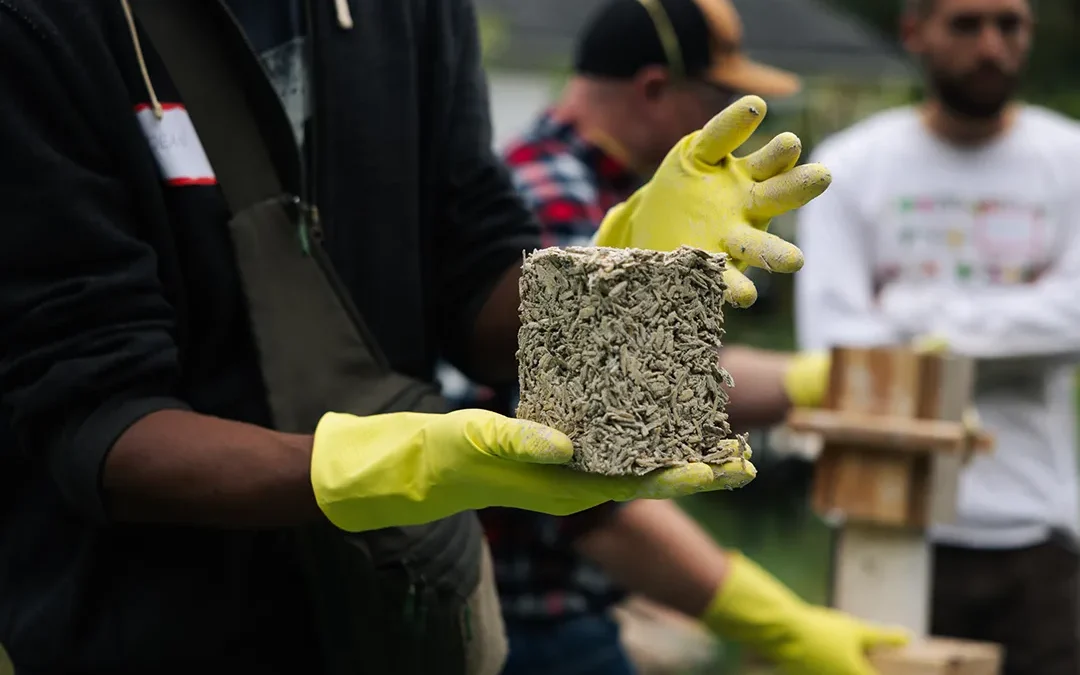
Hemp-lime construction, often called hempcrete, has taken an important step toward broader acceptance in the United States. The 2024 International Residential Code includes Appendix BL for hemp-lime construction, giving builders, designers, and code officials a clearer model-code pathway for certain residential projects.
That may sound technical, but it matters.
For years, hemp-lime builders had to work through alternative approval paths. That meant educating local building officials one project at a time. Some projects moved forward, but the process could be slow, uncertain, and expensive. A model-code appendix does not solve every problem, but it gives the industry something it badly needed: recognized code language.
Hemp-lime is made from the woody inner core of the hemp stalk, usually called hurd or shiv, mixed with a lime-based binder and water. It is commonly used as nonstructural wall infill or insulation. It is not a replacement for structural framing. The frame carries the load. The hemp-lime assembly helps create an insulating wall system.
That distinction is important. Hempcrete should not be oversold as a miracle material that replaces everything in a house. It is better understood as part of a wall assembly. Used correctly, it can contribute to thermal performance, moisture management, and a lower-carbon building approach. The U.S. Hemp Building Association describes hempcrete as a long-lasting fibrous insulation wall assembly and notes its appeal as a biogenic building material.
Appendix BL is especially important because it gives code officials a reference point. According to the U.S. Hemp Building Association, the appendix allows prescriptive use of hemp-lime in buildings up to two stories in regions of low seismic risk, while taller buildings or higher-risk regions may still require engineered design. The appendix is also optional, meaning state or local jurisdictions generally need to adopt it for it to become enforceable as part of their code.
That last point needs to be stated clearly: hemp-lime appearing in the 2024 IRC does not automatically mean every builder can use it everywhere without questions. Local adoption still matters. Local building officials still matter. Project scope still matters. Commercial, institutional, multi-family, or unusual projects may still need additional engineering or approval.
Even so, this is a major shift. When a material has recognized model-code language, it becomes easier to discuss with architects, builders, insurers, lenders, homeowners, and local officials. It reduces the feeling that hemp-lime is just an experimental material. It gives the industry a more professional starting point.
For farmers, this also matters. Building materials could become one of the stronger long-term markets for hemp hurd. If hemp-lime construction grows, it can create demand for processed hemp stalks, regional supply chains, and consistent material standards. That does not happen overnight, but codes are part of how markets become normal.
The opportunity now is education. Builders need to understand proper installation. Code officials need practical resources. Homeowners need honest expectations. Farmers need processors. Processors need buyers. The industry needs to avoid hype and focus on quality.
Hemp-lime construction is not going to replace conventional building overnight. But Appendix BL gives hemp a seat at the residential building table. That is progress worth building on.